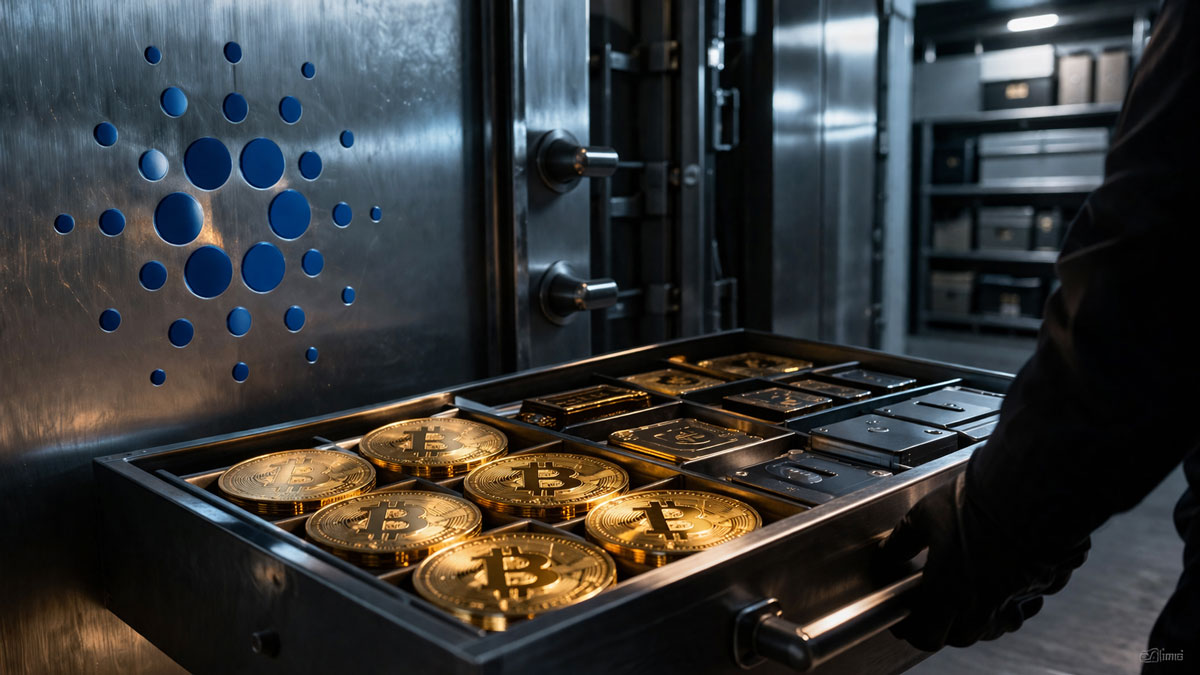
Cardano's Hoskinson Sounds Alarm on Quantum Threat: Is Crypto Ready for the Post-Quantum Era?
Market Pulse-4 / 10Bearish SentimentThe warning from a prominent figure about an existential long-term threat casts a cautious, slightly bearish sentiment, despite ongoing work towards solutions.As December...
Market Pulse
-4 / 10
Bearish SentimentThe warning from a prominent figure about an existential long-term threat casts a cautious, slightly bearish sentiment, despite ongoing work towards solutions.
As December 2025 draws to a close, the digital asset landscape buzzes with innovation, but a critical, long-term threat continues to loom: quantum computing. Charles Hoskinson, co-founder of Cardano, recently issued a stark warning, emphasizing that the crypto industry must accelerate its transition to post-quantum cryptography or face potential existential risks. This isn’t a distant science fiction scenario; advances in quantum technology are pushing the theoretical threat closer to reality, demanding immediate and coordinated action across all major blockchain protocols.
The Looming Quantum Threat to Cryptography
The foundation of modern cryptography, including the security of blockchain transactions and digital signatures, relies heavily on mathematical problems that are computationally infeasible for classical computers to solve within a practical timeframe. However, quantum computers, operating on principles of quantum mechanics, possess the theoretical capability to shatter these cryptographic bedrock elements. Algorithms like Shor’s algorithm could efficiently break widely used public-key cryptography (e.g., RSA and elliptic curve cryptography) that secure Bitcoin, Ethereum, and virtually every other blockchain.
- Shor’s Algorithm: Capable of factoring large numbers and solving discrete logarithm problems, which underpin most public-key encryption and digital signatures.
- Grover’s Algorithm: While not directly breaking public-key cryptography, it can significantly speed up brute-force attacks on symmetric-key algorithms and hash functions, effectively reducing their security margin.
- Timelines Accelerating: While full-scale fault-tolerant quantum computers are still some years away, the progress in quantum hardware and algorithms by late 2025 suggests that proactive measures are no longer optional.
Cardano’s Proactive Stance and Industry Initiatives
Hoskinson’s warning for Cardano, a protocol already known for its academic rigor, underscores a broader industry imperative. Developing and integrating quantum-resistant cryptographic algorithms, also known as post-quantum cryptography (PQC), is a monumental task. The National Institute of Standards and Technology (NIST) in the U.S. has been leading efforts to standardize PQC algorithms, with several candidates now in advanced stages. Major blockchains are beginning to explore or implement these new primitives.
- Algorithm Exploration: Projects are evaluating lattice-based cryptography (e.g., Dilithium, Kyber), hash-based signatures (e.g., SPHINCS+), and code-based cryptography, among others, for their suitability.
- Hard Fork Implications: Integrating PQC will likely require significant protocol upgrades, potentially involving network-wide hard forks, demanding careful planning and community consensus.
- Interoperability Challenges: Ensuring that new PQC standards remain compatible with existing infrastructure and future blockchain developments is a key hurdle.
Roadblocks and Trade-offs in PQC Implementation
The transition to post-quantum cryptography is not without its challenges. The new algorithms often come with trade-offs in terms of performance, key sizes, and complexity compared to their classical counterparts. Larger key sizes can increase transaction data, potentially impacting blockchain scalability and storage requirements. Furthermore, the rigorous testing and formal verification required for new cryptographic primitives in a high-stakes environment like blockchain demand extensive research and development.
The crypto community faces a delicate balancing act: adopting robust quantum-resistant solutions without introducing new vulnerabilities or significantly degrading network performance. Education and collaboration across developers, researchers, and users will be crucial to navigate this complex transition effectively and securely.
Conclusion
Charles Hoskinson’s call to action regarding the quantum threat serves as a timely reminder that long-term security must remain at the forefront of blockchain development. While the complete realization of a cryptographically relevant quantum computer might still be years away, the lead time for research, development, standardization, and deployment of post-quantum solutions is substantial. The industry’s ability to adapt and integrate these cutting-edge cryptographic advancements will ultimately determine the resilience and longevity of the decentralized future it aims to build.
Pros (Bullish Points)
- Drives accelerated innovation and research into cutting-edge cryptographic solutions, enhancing long-term blockchain resilience.
- Proactive adoption of post-quantum cryptography positions protocols for sustained security against future technological shifts.
Cons (Bearish Points)
- Implementing new cryptographic primitives will require complex, potentially disruptive hard forks and significant engineering challenges.
- Potential for increased transaction data size and performance overheads with new algorithms, impacting network scalability.
Frequently Asked Questions
What is post-quantum cryptography (PQC)?
PQC refers to cryptographic algorithms designed to be secure against attacks by both classical and quantum computers, developed to replace current vulnerable standards.
Why is quantum computing a threat to blockchain?
Quantum computers, especially with Shor's algorithm, could efficiently break the public-key cryptography used for digital signatures and wallet security on most blockchains, exposing funds.
How is Cardano (ADA) addressing this threat?
Cardano, through its research-driven approach, is actively exploring and evaluating post-quantum cryptographic algorithms and planning for their eventual integration into its protocol to ensure long-term security.
Disclaimer: The information in this article should not be considered financial advice, and FXCryptoNews articles are intended only to provide educational and general information. Please consult with a financial advisor before making any investment decisions.
Delegate Your Voting Power to FEED DRep in Cardano Governance.
DRep ID: drep12ukt4ctzmtf6l5rj76cddgf3dvuy0lfz7uky08jfvgr9ugaapz4 | We are driven to register as a DRep by our deep dedication to the Cardano ecosystem and our aspiration to take an active role in its development, ensuring that its progress stays true to the principles of decentralization, security, and community empowerment.DELEGATE VOTING POWER!